


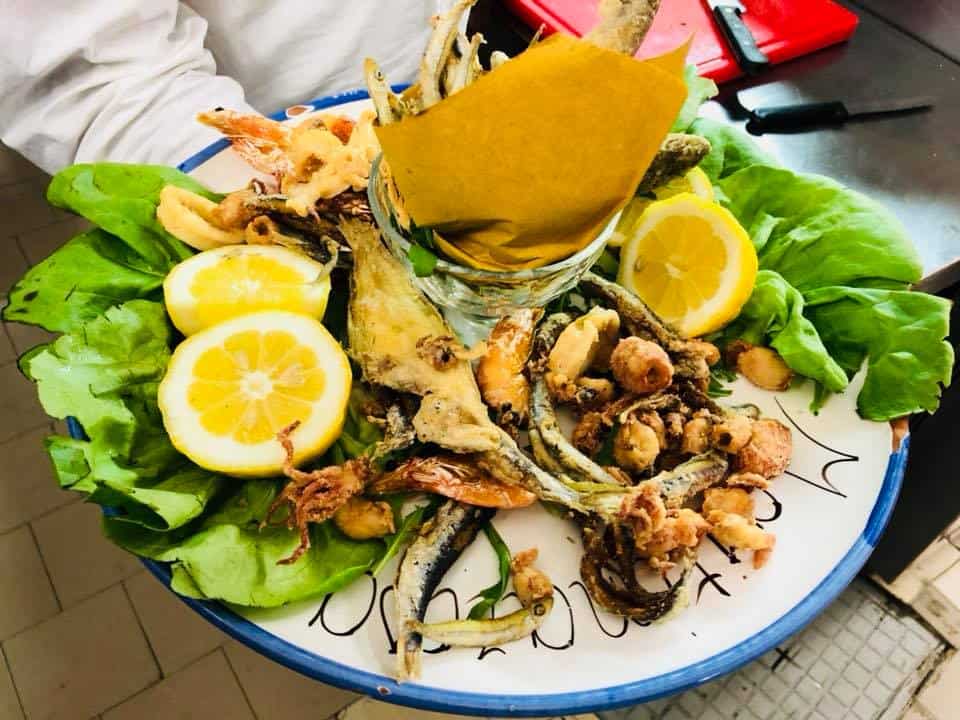
Paranza Fish Fry (Neapolitan Mixed Fried Fish or Fritto di Paranza) is one of those dishes that tells the story of the sea better than any description. Born from the tradition of local fishermen, it has become over time one of the symbols of Campania seafood cuisine — simple in technique, extraordinary in result when the fish is fresh and the frying is done right.
What does “paranza” mean
Paranza is a type of trawling net that Neapolitan fishermen used to catch small fish along the seabed. The name also referred to the boats that used this net — the paranza boats — and by extension came to describe the catch itself: that variety of small, mixed fish the net would gather together.
The paranza catch was not the prized fish sold at market — it was what the fishermen kept for themselves, the mixed and small fish that would be floured and fried on the spot. From a humble dish of the maritime tradition, it has become one of the most requested in restaurants throughout Campania.
Which fish make up the fritto di paranza
There is no fixed composition — the fritto di paranza changes according to what the sea offers at any given moment. This variability is precisely what makes it special, because each season brings different fish and every plate is unique.
The most common fish are anchovies, whitebait, small hake, cicinielli — the fry of small blue fish —, red mullet, baby cuttlefish, small squid and tiny prawns. Sometimes you find small sole, zanchette or little pezzogne. What they have in common is their small size and absolute freshness — fritto di paranza does not forgive fish that is not fresh.
In the Gulf of Naples the catch is particularly rich thanks to the depth of the seabed and the presence of an underwater volcano that warms the waters — conditions that favour a fish biodiversity few other seas in the Mediterranean can match. In Ischia, overlooking this same gulf, fritto di paranza is a dish of the territory in the most authentic sense of the word.
How fritto di paranza is prepared
The technique is simple but requires attention at every step. The quality of the result depends almost entirely on the freshness of the fish and the management of the oil.
The small fish are cleaned — the anchovies gutted, the cuttlefish emptied — then dried thoroughly with kitchen paper. Drying is fundamental because moisture is the enemy of a crispy fry.
The fish are dredged in plain wheat flour — some use semolina for a rougher crust — shaking off the excess. Batter is not used: just flour, nothing else.
The oil must be plentiful and very hot, around 180 degrees. Only a few fish are fried at a time so as not to lower the oil temperature — this is the most common mistake that turns a crispy fry into a soft, greasy one. A few minutes is all it takes, just until the fish turns golden.
Drain on kitchen paper, salt only at the end — never before frying because salt draws out moisture — and serve immediately. The Neapolitan Mixed Fried Fish does not wait.
Book with Martinarosa
How to recognise a good frittura di paranza at a restaurant
There are three signs that distinguish a well-made frittura di paranza from a mediocre one.
The first is crispiness — it must be dry, light, never greasy. If the paper under the fried fish becomes soaked in oil, the fish was not dry enough or the oil was not at the right temperature.
The second is the smell — it must smell of sea and clean frying, not of old oil or frozen fish. Fresh fish that has been fried has an unmistakable sweet, marine aroma.
The third is the composition — an authentic one has variety. If the plate contains only squid and king prawns it is a generic mixed seafood fry. True paranza has at least four or five different types of catch, all strictly small.
Where to eat fritto di paranza in Ischia
In Ischia this special Mixed Fried Fish appears on the menu of almost every seafood restaurant, but the difference between one version and another is enormous. The deciding factor is always the same — the freshness of the fish.
At Martinarosa restaurant and pizzeria in Forio, fritto di paranza is prepared with fresh catch from the Gulf of Naples that arrives every day. The composition changes according to the season and what the sea offers — exactly as tradition demands. It is served on the terrace overlooking the port, with a view that alone is worth the trip.